Quick Answer:
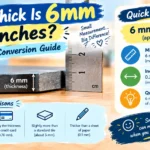
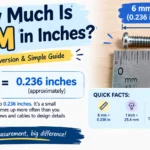
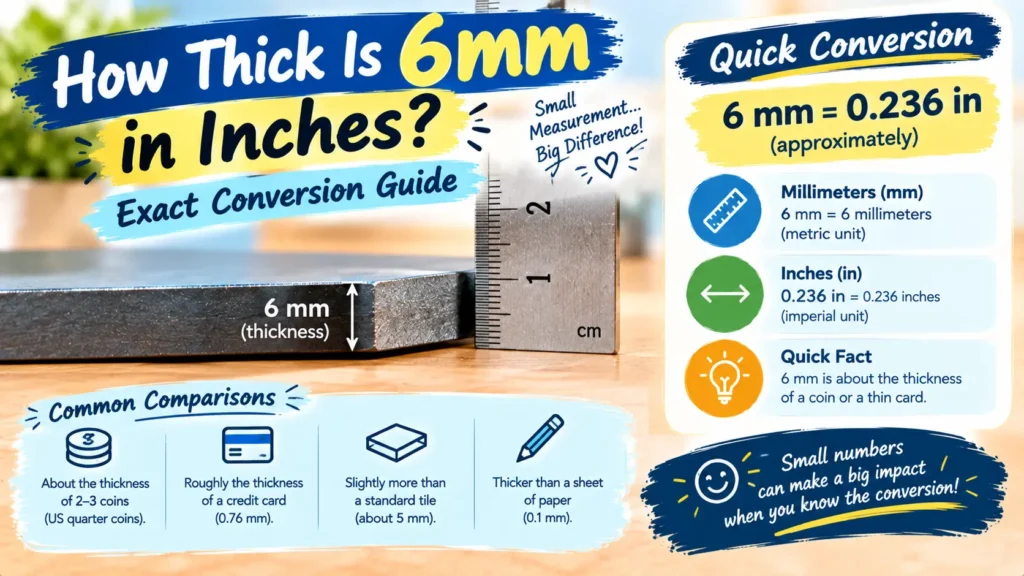
6 millimeters (mm) is approximately 0.236 inches thick. In everyday terms, 6mm is a little less than ¼ inch.
Formula:
Millimeters ÷ 25.4 = Inches
6 ÷ 25.4 = 0.236 inches
If you are wondering how thick is 6mm in inches, you are trying to picture a measurement that is common in products, materials, tools, and everyday objects. Six millimeters may sound small, but it appears in many practical situations, from glass and metal sheets to phone accessories and construction materials. Understanding this thickness helps you choose the right size when shopping, building, crafting, or comparing measurements. Below, you’ll find easy conversions, real-life examples, and visual references that make 6mm thickness simple to understand.
6mm to Inches Conversion Chart
The easiest way to understand 6mm is to compare it with nearby inch measurements.
| Millimeters (mm) | Inches (in) | Approximate Fraction |
|---|---|---|
| 1 mm | 0.039 inches | About 1/25 inch |
| 2 mm | 0.079 inches | About 1/13 inch |
| 3 mm | 0.118 inches | About ⅛ inch |
| 4 mm | 0.157 inches | About ⅙ inch |
| 5 mm | 0.197 inches | About ⅕ inch |
| 6 mm | 0.236 inches | Just under ¼ inch |
| 7 mm | 0.276 inches | About ¼ inch |
| 8 mm | 0.315 inches | About ⅓ inch |
| 10 mm | 0.394 inches | About ⅜ inch |
What Does 6mm Thickness Mean?
A measurement of 6mm describes the distance from one side of an object to the other. When you convert it to inches, 6mm equals about 0.236 inches, which is slightly thinner than a quarter inch.
The metric system uses millimeters for small measurements, while inches are commonly used in the United States for tools, construction, manufacturing, and everyday sizing.
Because 1 inch equals exactly 25.4 millimeters, converting between the two systems is straightforward.
For example:
- 25.4mm = 1 inch
- 12.7mm = ½ inch
- 6.35mm = ¼ inch
- 6mm = 0.236 inches
So, 6mm is very close to a quarter inch but not exactly the same.
Why Does 6mm Thickness Matter?
Thickness measurements help people select the right material or product for a specific purpose.
A difference of only a few millimeters can affect:
- Strength
- Flexibility
- Weight
- Durability
- Fit and compatibility
For example, a 6mm piece of glass is much stronger than a thinner 3mm sheet, while a 6mm cable or wire may be too thick for a space designed for a smaller size.
Real-Life Examples: How Thick Is 6mm?
Example 1: A Standard Pencil Diameter
Measurement: About 6–8mm
Visualization:
A regular wooden pencil is close to the same thickness range as 6mm.
Why it helps:
Most people handle pencils daily, making them an easy reference point.
Interesting insight:
The familiar feel of a pencil gives a good sense of how a 6mm object feels in your hand.
Example 2: Medium Glass Thickness
Measurement: 6mm
Visualization:
Imagine a glass panel slightly thinner than a quarter-inch ruler marking.
Why it helps:
Many decorative and protective glass products use measurements close to this range.
Interesting insight:
A few millimeters can make a noticeable difference in glass strength.
Example 3: Smartphone Thickness Comparison
Measurement: Modern smartphones are often around 7–9mm thick.
Visualization:
A 6mm object is slightly thinner than many phones.
Why it helps:
Most people know how a phone feels in their hand.
Interesting insight:
Phone thickness is measured in millimeters because small differences matter.
Example 4: Stack of Coins
Measurement: Around 6mm
Visualization:
A small stack of coins can approach this thickness depending on the coin type.
Why it helps:
Coins provide a familiar object for visual comparison.
Interesting insight:
Small stacked objects are useful for estimating thickness without tools.
Example 5: Wood Panels
Measurement: 6mm plywood or wood sheet
Visualization:
Think of a thin craft board or lightweight panel.
Why it helps:
DIY projects often use thin sheets measured in millimeters.
Interesting insight:
Thin wood can still be useful for models, crafts, and decorative work.
Example 6: Plastic Sheets
Measurement: 6mm plastic
Visualization:
A rigid plastic sheet slightly thinner than ¼ inch.
Why it helps:
Plastic thickness affects whether it bends or stays firm.
Interesting insight:
Manufacturers select thickness based on strength and flexibility needs.
Example 7: Metal Plates
Measurement: 6mm steel or aluminum
Visualization:
A thin but sturdy metal strip.
Why it helps:
Metal thickness is critical in fabrication and engineering.
Interesting insight:
A 6mm metal plate can be surprisingly strong compared with softer materials.
Example 8: Tile Thickness
Measurement: Around 6mm
Visualization:
Some wall tiles and decorative tiles are close to this thickness.
Why it helps:
Tile thickness affects installation and surface height.
Interesting insight:
A few millimeters can change how flooring or walls line up.
Example 9: Wire or Cable Diameter
Measurement: Some wires measure near 6mm in diameter.
Visualization:
About the thickness of a pencil.
Why it helps:
Cable sizing matters for electrical, mechanical, and industrial applications.
Interesting insight:
A thicker cable usually handles different loads than a thinner one.
Example 10: Foam and Rubber Materials
Measurement: 6mm
Visualization:
A thin protective padding layer.
Why it helps:
Foam thickness changes comfort and shock absorption.
Interesting insight:
Many protective products use millimeter measurements because precision matters.
6mm Compared With Other Measurements
Understanding 6mm becomes easier when you compare it.
| Measurement | Compared With 6mm |
|---|---|
| 1mm | Much thinner |
| 3mm | Half as thick |
| 5mm | Slightly thinner |
| 6mm | Reference thickness |
| 10mm | About 67% thicker |
| 12mm | Twice as thick |
| 25.4mm | Over 4 times thicker (1 inch) |
6mm Compared to Everyday Objects
| Object | Approximate Thickness |
|---|---|
| Sheet of paper | 0.1mm |
| Credit card | About 0.76mm |
| Pencil | Around 6–8mm |
| Smartphone | Around 7–9mm |
| Quarter coin | About 1.75mm thick |
| ¼ inch | 6.35mm |
A 6mm thickness is much thicker than paper but still considered a thin measurement for solid materials.
How Does 6mm Feel in Real Life?
A 6mm object feels:
- Thin but noticeable
- Easy to hold between fingers
- Not flexible in many rigid materials
- Small enough to fit into narrow spaces
If you hold something that is 6mm thick, it feels closer to a pencil or small cable than a thin sheet of paper.
For walking or height comparisons, 6mm is extremely small:
- A person’s fingernail length is often several millimeters.
- A single step is thousands of millimeters.
- Human height is measured in thousands of millimeters.
This shows how tiny 6mm is compared with larger dimensions.
Practical Uses of 6mm Measurements
Construction
Builders use 6mm measurements for:
- Tiles
- Panels
- Glass
- Hardware
- Materials
Precise thickness helps ensure correct fitting.
Interior Design
Designers consider thickness when choosing:
- Shelves
- Decorative panels
- Flooring materials
- Wall coverings
A small thickness change can affect alignment.
DIY Projects
People use 6mm materials for:
- Craft boards
- Model making
- Small repairs
- Protective layers
A 6mm sheet is often easy to cut and handle.
Manufacturing
Factories measure thickness for:
- Plastic parts
- Metal components
- Machine pieces
- Product designs
Accuracy prevents fitting problems.
Education
Students learn millimeter-to-inch conversions because measurements appear in:
- Science
- Engineering
- Math
- Technical drawings
Frequently Asked Questions About 6mm in Inches
How thick is 6mm in inches exactly?
6mm equals 0.23622 inches exactly when converted using the standard conversion of 25.4mm per inch. It is commonly rounded to 0.24 inches or described as slightly less than ¼ inch.
Is 6mm the same as ¼ inch?
No. A quarter inch equals 6.35mm, while 6mm equals 0.236 inches. The difference is small, but 6mm is slightly thinner than ¼ inch.
What fraction of an inch is 6mm?
6mm is approximately 15/64 of an inch. In everyday use, people usually describe it as just under ¼ inch.
How do I convert 6mm to inches?
Divide the millimeter measurement by 25.4.
Example:
6 ÷ 25.4 = 0.236 inches
Is 6mm considered thick?
It depends on the material. A 6mm sheet of glass or metal can be strong, while 6mm foam or plastic may be considered thin.
What objects are about 6mm thick?
Objects near 6mm include pencils, some cables, thin boards, and certain glass or plastic sheets.
How thick is 6mm compared with a coin?
A 6mm object is thicker than most individual coins. Many coins are around 1–2mm thick.
Can I measure 6mm without a ruler?
You can estimate it by comparing it with familiar objects like a pencil diameter, but an actual ruler or caliper provides the most accurate measurement.
Why are measurements given in millimeters?
Millimeters allow precise measurements of small objects. They are widely used in engineering, manufacturing, tools, and product specifications.
What is 6mm in centimeters?
Since 10mm equals 1cm, 6mm equals 0.6 centimeters.
Conclusion
So, how thick is 6mm in inches? The answer is about 0.236 inches, which is slightly less than ¼ inch. While 6mm is a small measurement, it appears in many everyday items such as pencils, glass panels, plastic sheets, cables, and construction materials.
Understanding this conversion makes it easier to visualize products, compare sizes, and choose the right materials for DIY projects, shopping, and planning.