
Quick Answer
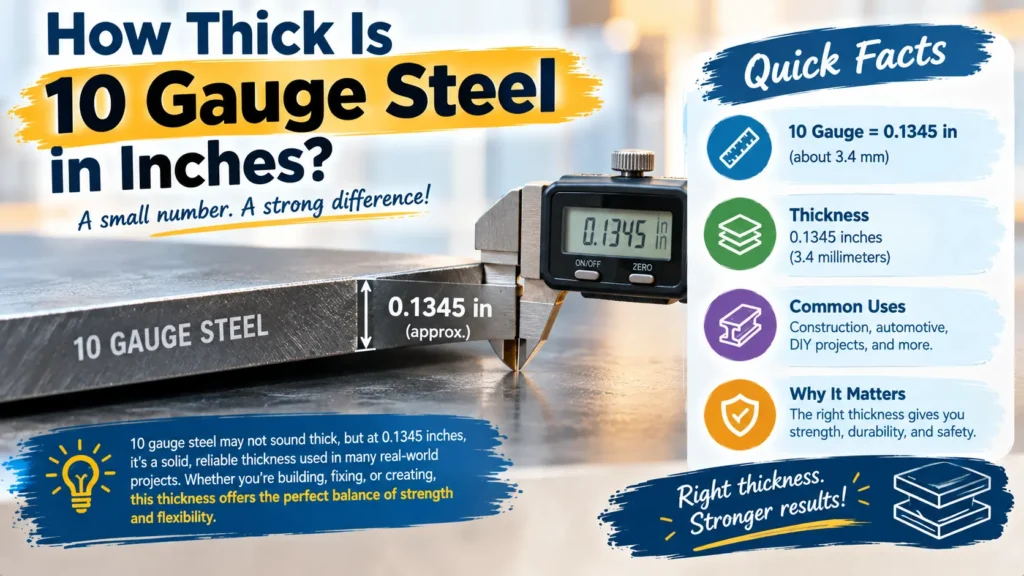
10 gauge steel is 0.1345 inches thick (approximately 3.42 mm) in standard sheet steel measurements.
Formula (Gauge to Thickness):
Gauge number → Fixed standard thickness value (varies by material type)
For steel: 10 gauge = 0.1345 inches
When you try to picture how thick is 10 gauge steel in inches, it can feel confusing because “gauge” doesn’t behave like normal measurements. Unlike inches or centimeters, gauge numbers don’t increase logically with size—instead, the higher the gauge, the thinner the metal becomes.
So what does 0.1345 inches actually look like in real life? Think of something slightly thicker than two stacked credit cards, but still thin enough to bend under enough force. That’s the kind of real-world understanding you need when choosing steel for construction, automotive panels, appliances, or DIY metal projects.
In this guide, you’ll find clear comparisons, conversion charts, and real-life examples to help you instantly visualize the thickness and use it confidently in practical situations.
Conversion / Core Data Table (Steel Gauge to Inches)
| Gauge Number | Thickness (inches) | Thickness (mm) | Common Use |
|---|---|---|---|
| 8 gauge | 0.1644 in | 4.18 mm | Heavy structural parts |
| 10 gauge | 0.1345 in | 3.42 mm | Industrial panels, brackets |
| 12 gauge | 0.1046 in | 2.66 mm | Light structural work |
| 14 gauge | 0.0747 in | 1.90 mm | Sheet metal fabrication |
| 16 gauge | 0.0598 in | 1.52 mm | HVAC ducts, enclosures |
Main Explanation: What 10 Gauge Steel Means
The term “10 gauge steel” comes from the sheet metal gauge system, a standardized numbering method used in metal manufacturing.
This system is maintained through industrial standards influenced by organizations like the American Society for Testing and Materials (ASTM), which helps define material thickness consistency across industries.
Key idea:
- Lower gauge number = thicker steel
- Higher gauge number = thinner steel
So, 10 gauge steel is thicker than 12, 14, or 16 gauge steel.
Why it matters:
Thickness affects:
- Strength and load capacity
- Weight of the material
- Weldability and bending resistance
- Cost of fabrication
Important note:
Gauge is not universal across all materials. For example:
- Steel and aluminum use different gauge scales
- Stainless steel may slightly differ depending on grade
But for standard sheet steel, 10 gauge remains 0.1345 inches.
Real-Life Examples (8–15 Practical Comparisons)
Example 1: Two Credit Cards + Extra Layer
- Thickness: ~0.1345 inches
- Visualization: Two credit cards stacked with a thin metal sheet on top
- Insight: Slightly rigid, not flexible like paper
Example 2: US Nickel Stack
- Thickness: About 5–6 nickels stacked
- Visualization: Small coin stack you can pinch easily
- Insight: Still compact, but noticeably solid
Example 3: Heavy Kitchen Appliance Panels
- Thickness: 10 gauge steel
- Visualization: Side panels of commercial ovens or grills
- Insight: Built for heat and durability
Example 4: Industrial Metal Cabinets
- Thickness: 0.1345 inches
- Visualization: Strong storage lockers in factories
- Insight: Resistant to dents and bending
Example 5: Car Chassis Reinforcement
- Thickness: Similar range
- Visualization: Structural support under vehicles
- Insight: Adds crash resistance
Example 6: Garage Door Reinforcement Strips
- Thickness: Close match
- Visualization: Metal braces inside doors
- Insight: Prevents warping over time
Example 7: Handrail Supports
- Thickness: Standard 10 gauge steel
- Visualization: Rail brackets in staircases
- Insight: Holds heavy loads safely
Example 8: Metal Workbenches
- Thickness: 10 gauge steel tops
- Visualization: Workshop tables for tools and machinery
- Insight: Can withstand hammering and heavy equipment
Example 9: Security Doors
- Thickness: 10 gauge or thicker
- Visualization: Bank or vault-style doors
- Insight: Designed for protection and strength
Example 10: Farm Equipment Frames
- Thickness: 10 gauge steel sections
- Visualization: Tractor attachments
- Insight: Built for rough outdoor use
Comparison Section
Smaller than 10 gauge:
- 12 gauge (0.1046 in) → noticeably thinner
- 14 gauge (0.0747 in) → flexible sheet metal
- 16 gauge (0.0598 in) → lightweight HVAC material
Larger than 10 gauge:
- 8 gauge (0.1644 in) → much heavier, industrial-grade
- 6 gauge (~0.194 in) → structural steel
- 4 gauge (~0.224 in) → extremely thick, load-bearing steel
Everyday comparisons:
- Thicker than a U.S. nickel stack
- Thinner than a standard pencil
- Similar feel to a sturdy metal ruler, but heavier
How It Feels in Real Life
If you hold a 10 gauge steel sheet in your hands, you’ll notice:
- It feels solid and firm, not flimsy
- It resists bending unless force is applied
- It has noticeable weight compared to thinner sheet metal
- It produces a strong metallic “clink” when tapped
Think of it like the difference between:
- A soda can (thin gauge)
- Versus a car door panel (around 10–12 gauge range)
You’re firmly in the “structural strength” zone, not decorative metal.
Practical Uses of 10 Gauge Steel
You’ll commonly see 10 gauge steel in:
Construction
- Structural frames
- Support beams
- Reinforcement plates
Automotive Industry
- Chassis components
- Heavy-duty brackets
- Protective panels
Manufacturing
- Machine housings
- Industrial enclosures
- Tooling platforms
Interior & Commercial Design
- Industrial furniture
- Security doors
- Storage systems
DIY & Fabrication
- Welding projects
- Workbenches
- Custom metal builds
FAQ Section
How thick is 10 gauge steel in inches exactly?
10 gauge steel is exactly 0.1345 inches thick in standard sheet steel measurements. This is equal to approximately 3.42 mm, making it a medium-heavy steel thickness used in industrial and structural applications.
Is 10 gauge steel strong?
Yes, 10 gauge steel is considered strong and durable. It is commonly used in structural frames, heavy equipment, and industrial fabrication where resistance to bending and impact is important.
What is thicker, 10 gauge or 12 gauge steel?
10 gauge steel is thicker than 12 gauge steel. Lower gauge numbers always represent thicker material in the steel gauge system.
Can 10 gauge steel bend easily?
No, 10 gauge steel does not bend easily by hand. It requires mechanical force or specialized tools like press brakes or hydraulic benders.
What is 10 gauge steel used for?
It is used in construction, automotive parts, industrial machines, heavy-duty furniture, and structural reinforcement applications.
How heavy is 10 gauge steel?
Weight depends on sheet size, but 10 gauge steel is significantly heavier than thinner sheet metal and is considered a structural-grade material.
Is 10 gauge steel good for welding?
Yes, it is excellent for welding. Its thickness allows strong weld joints without burning through easily, making it ideal for fabrication work.
How does 10 gauge steel compare to 1/8 inch?
10 gauge steel (0.1345 in) is slightly thicker than 1/8 inch (0.125 in), making it marginally stronger and more rigid.
What industries use 10 gauge steel the most?
It is widely used in construction, automotive manufacturing, agriculture equipment, and industrial fabrication.
Conclusion
10 gauge steel, measuring 0.1345 inches thick, sits in the sweet spot between flexibility and heavy-duty strength. It’s thick enough for structural support but still workable for fabrication and welding projects.
Once you understand how it compares to everyday objects and other gauge sizes, choosing the right steel becomes much easier—especially for construction, automotive, or DIY metalwork.