
If you’ve ever looked at a recipe, a medicine bottle, or a perfume box and wondered what the milliliter number means in ounces — you’re not alone. Converting milliliters to ounces is one of the most common kitchen and shopping questions, because the US uses ounces while most of the world labels things in milliliters.
Use the free converter below for an instant answer, then keep reading for the simple formula, a quick chart, and easy explanations of everything around it.
What Is a Milliliter?
A milliliter (ml) is a tiny unit of volume from the metric system. There are 1,000 milliliters in one liter. It’s exactly the same size as one cubic centimeter — the “cc” you might see on a medicine syringe.
You’ll see milliliters everywhere:
- Medicine droppers and dosing syringes
- Perfume, skincare, and shampoo bottles
- Soda bottles and juice cartons from other countries
- Measuring cups with metric markings
What Is a Fluid Ounce?
A fluid ounce (fl oz) is a US unit for measuring volume — how much space a liquid takes up. One US fluid ounce is the same as 1/8 of a US cup.
Here’s the trap most people fall into: a fluid ounce is not the same as a regular ounce. Fluid ounces measure volume (like water in a glass). Regular ounces measure weight (like flour on a scale). A fluid ounce of water weighs about one ounce — but a fluid ounce of honey weighs much more, because honey is heavier. So never mix the two up.
The Simple Formula
Everything comes down to one number: 1 US fluid ounce = 29.5735 milliliters.
- ml → fl oz: divide by 29.5735. Example: 100 ÷ 29.5735 = 3.38 fl oz
- fl oz → ml: multiply by 29.5735. Example: 2 × 29.5735 = 59.15 ml
Quick mental shortcut: round it to 30 ml per ounce in your head. 100 ml is a bit more than 3 oz, 250 ml is a bit more than 8 oz. It’s not exact, but it’s perfect for cooking and everyday guessing. When exactness matters — medicine, lab work, anything official — always use 29.5735.
US vs UK Fluid Ounces: They’re Different!
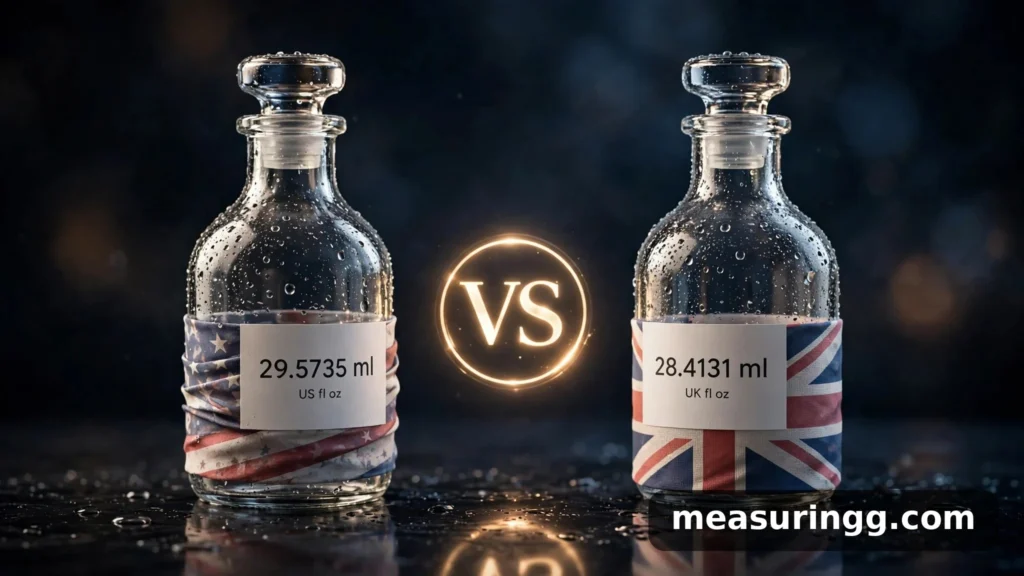
Careful — there are two kinds of fluid ounces. The US fluid ounce (29.5735 ml) and the UK Imperial fluid ounce (28.4131 ml) are not the same size. The UK one is a little smaller.
| Standard | 1 fl oz equals | Use it for |
|---|---|---|
| US fluid ounce | 29.5735 ml | US recipes, US products |
| UK Imperial fluid ounce | 28.4131 ml | British recipes, UK products |
Example: 250 ml = 8.45 US fl oz, but 8.80 UK fl oz. Same liquid, different answer! The converter above lets you switch between the two, so always check which country your recipe or label comes from.
Common Conversions Chart
Save this chart — it covers the values people look up most:
| Milliliters | US fl oz | Milliliters | US fl oz |
|---|---|---|---|
| 5 ml | 0.17 | 250 ml | 8.45 |
| 10 ml | 0.34 | 300 ml | 10.14 |
| 15 ml | 0.51 | 350 ml | 11.83 |
| 30 ml | 1.01 | 500 ml | 16.91 |
| 50 ml | 1.69 | 750 ml | 25.36 |
| 100 ml | 3.38 | 1000 ml | 33.81 |
| 200 ml | 6.76 |
All values are ml ÷ 29.5735, rounded to two decimals.
Quick Answers to Popular Conversions
How many ounces is 5 ml?
5 ml = 0.17 fl oz. That’s about one teaspoon — handy for medicine droppers and small recipe amounts.
How many ounces is 50 ml?
50 ml = 1.69 fl oz. A very common travel-size bottle (shampoo, lotion, mini liquor bottles).
How many ounces is 100 ml?
100 ml = 3.38 fl oz. The classic travel-size limit for carry-on liquids at airports, and a standard perfume bottle size.
How many ounces is 250 ml?
250 ml = 8.45 fl oz. Just over one US cup — a typical small water bottle or a large coffee.
How many ounces is 350 ml?
350 ml = 11.83 fl oz. A little less than a standard 12 oz soda can — picture a can and take a small sip off the top.
How many ounces is 500 ml?
500 ml = 16.91 fl oz. A standard half-liter water bottle — about 2 cups.
How many ounces is 1000 ml?
1000 ml = 33.81 fl oz. That’s exactly one liter — about 4¼ US cups, the size of a big water bottle.
Everyday Uses: Where You’ll Need This
Cooking and recipes
Recipes from other countries list liquids in milliliters, while US recipes use cups and ounces. 120 ml of milk is about 4 fl oz (half a cup). 15 ml is one tablespoon, 5 ml is one teaspoon — memorize those two and half of cooking conversions become easy.
Medicine and dosing
Children’s medicines are almost always dosed in milliliters, even in the US. The 30 ml ≈ 1 oz shortcut is fine for understanding, but always measure medicine with the syringe or cup that comes in the box — never with a kitchen spoon. Small mistakes in ml become bigger mistakes when you guess in ounces.
Skincare and perfume
Beauty products are labeled in both units because they’re sold worldwide. Now you know: 30 ml ≈ 1.01 fl oz (travel size), 50 ml ≈ 1.69 fl oz, 100 ml ≈ 3.38 fl oz (full-size perfume). This makes comparing prices across brands much easier.
5 Mistakes to Avoid
- Mixing up fluid ounces and weight ounces. One measures volume, the other measures weight. They’re only equal for water.
- Using the US number for a UK recipe (or the reverse). 29.5735 vs 28.4131 — pick the right one.
- Trusting the “30 ml = 1 oz” shortcut for medicine. Fine for cooking, dangerous for dosing.
- Rounding too early. If you’re converting several ingredients, keep the decimals until the final answer.
- Forgetting the converter works both ways. Type in either box — ml or fl oz — and it converts instantly.
Frequently Asked Questions
How do you convert ml to oz?
Divide the milliliters by 29.5735 for US fluid ounces. Example: 200 ml ÷ 29.5735 = 6.76 fl oz. For UK Imperial fluid ounces, divide by 28.4131 instead.
How many ml are in 8 oz?
8 US fluid ounces = 236.59 ml (8 × 29.5735). That’s just under a quarter of a liter — and almost exactly one US cup (236.59 ml).
Is 30 ml the same as 1 oz?
Almost, but not exactly. 1 US fl oz is 29.5735 ml, so 30 ml is about 1.4% more. The 30 ml shortcut is fine for cooking but not for medicine or anything official.
What’s the difference between oz and fl oz?
“Oz” alone usually means weight (how heavy something is). “Fl oz” means volume (how much space a liquid fills). A fluid ounce of water weighs about an ounce, but for anything thicker or thinner — honey, oil, alcohol — the two numbers are different.
How many ounces is 750 ml?
750 ml = 25.36 US fl oz. That’s the standard wine bottle size — about 3¼ cups.
Does the converter work for UK ounces too?
Yes. Switch the toggle at the top of the converter to “UK Imperial fl oz” and it will use 28.4131 ml per ounce instead of 29.5735.
How many ml is 12 oz?
12 US fluid ounces = 354.88 ml (12 × 29.5735). Useful to know: a “12 oz” soda can actually holds about 355 ml.
Why do bottles show both ml and oz?
US labeling rules require fluid ounces on packaging, while most other countries require milliliters. International brands print both so one bottle works everywhere.
Conclusion
Converting milliliters to ounces is easy once you know the magic number: 29.5735. Divide ml by it to get US fluid ounces, multiply to go back — and remember the UK uses 28.4131 instead. The converter above does it both ways instantly, with US/UK switching and handy cup, tablespoon, and teaspoon equivalents built in. Bookmark this page, and you’ll never stare at a milliliter label in confusion again.