
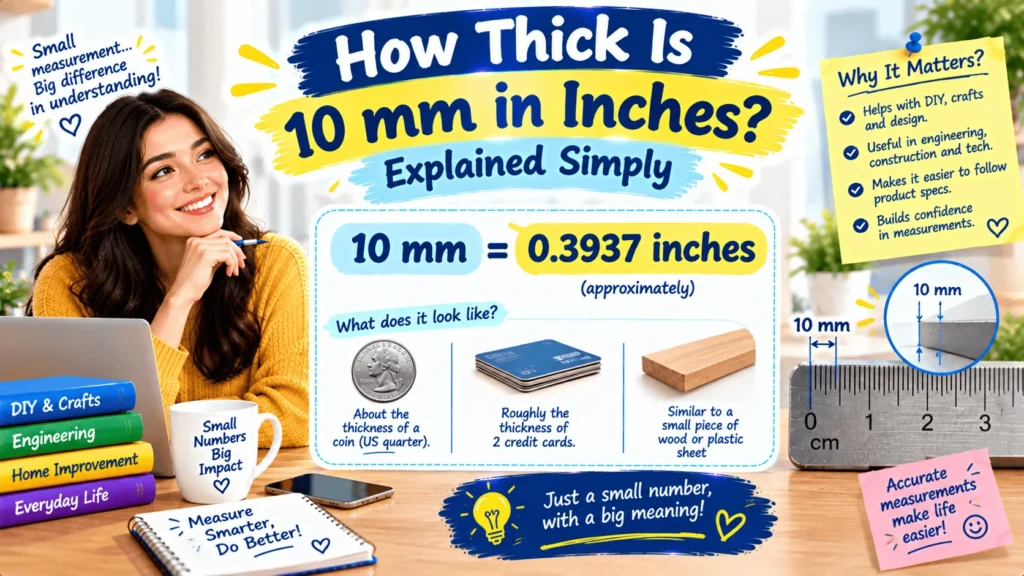
Quick Answer
10 mm is equal to 0.3937 inches (approximately 0.39 inches).
Formula:
Millimeters × 0.03937 = Inches
So, 10 × 0.03937 = 0.3937 inches
If you’re trying to understand how thick is 10 mm in inches in real life, you’re not alone. Millimeters can feel abstract until you connect them to everyday objects you already see and touch. At just under half an inch, 10 mm is a small but noticeable thickness—often used in construction materials, glass, jewelry, and tools.
To help you visualize it, think of stacked coins, pencil thickness, or a slim smartphone profile. In this guide, you’ll get clear comparisons, conversion charts, and real-world examples so you can instantly picture what 10 mm looks like without guessing.
Conversion Table: Millimeters to Inches
| Millimeters (mm) | Inches (in) | Approximate Fraction |
|---|---|---|
| 1 mm | 0.039 in | very thin line |
| 5 mm | 0.197 in | ~1/5 inch |
| 10 mm | 0.394 in | ~3/8 inch |
| 12 mm | 0.472 in | ~1/2 inch (close) |
| 20 mm | 0.787 in | ~4/5 inch |
| 25.4 mm | 1 inch | exact conversion |
What Does 10 mm Mean?
10 millimeters is a metric unit of length used globally in science, engineering, manufacturing, and everyday measurements. In simple terms:
- 1 millimeter is very small (about the thickness of a credit card edge)
- 10 mm is 10 of those tiny units stacked together
- In imperial units, it becomes just under 0.4 inches
So when someone asks how thick is 10 mm in inches, they are usually trying to visualize a thin but solid object—not paper-thin, but still compact.
Why This Conversion Matters
Understanding 10 mm in inches is important because:
- Many countries use different systems (metric vs imperial)
- Product specifications often mix both units
- DIY and construction materials require accurate sizing
- Online shopping descriptions frequently switch between mm and inches
Knowing this conversion helps you avoid mistakes when buying or measuring materials.
Real-Life Examples of 10 mm Thickness
Here are practical, everyday comparisons to help you visualize 10 mm clearly:
Example 1: Standard Pencil Diameter
- Measurement: ~7–10 mm
- Visualization: A regular wooden pencil is almost the same thickness
- Why it helps: You’ve held a pencil thousands of times—this is your easiest reference
Example 2: Stack of 5–6 Coins
- Measurement: ~10 mm
- Visualization: Stack a few coins like nickels or similar-sized coins
- Insight: Coin stacks are often used in quick measuring tricks
Example 3: Smartphone Thickness (Slim Models)
- Measurement: 8–10 mm
- Visualization: Many modern phones are just slightly thinner or equal
- Why it helps: You interact with phones daily
Example 4: Two Credit Cards Together
- Measurement: ~1 mm per card → 10 cards ≈ 10 mm
- Visualization: Stack multiple cards to feel the thickness
- Insight: Credit cards are a reliable millimeter reference
Example 5: Small Wall Tile Thickness
- Measurement: 8–12 mm
- Visualization: Ceramic tiles used in bathrooms
- Why it helps: Common in home interiors
Example 6: Wooden Craft Board
- Measurement: ~10 mm plywood
- Visualization: Thin craft wood used in DIY projects
- Insight: Popular in furniture backing panels
Example 7: Standard USB Drive Height
- Measurement: ~8–12 mm
- Visualization: A USB stick’s thickness
- Why it helps: Easily found in your bag or laptop case
Example 8: Thick Notebook Cover
- Measurement: ~10 mm for hardcover binding sections
- Visualization: A sturdy school notebook spine
- Insight: Common in stationery items
Example 9: Glass Panel (Decorative)
- Measurement: 10 mm tempered glass
- Visualization: Used in tabletops and railings
- Why it matters: Strong and load-bearing thickness
Example 10: Coin Stack (Detailed)
- Measurement: 1 mm per coin average
- Visualization: 10 coins stacked neatly
- Insight: Great for quick estimation without tools
Comparison Section: 10 mm vs Other Sizes
Smaller than 10 mm
- 1 mm → almost invisible thickness
- 5 mm → thin wire or small screw size
- 8 mm → slightly thinner than a pencil
Equal to 10 mm
- Pencil thickness
- Slim smartphone body
- Small hardware bolts
Larger than 10 mm
- 12 mm → close to 1/2 inch
- 20 mm → thicker than a marker
- 25.4 mm → exactly 1 inch
Human Body Comparison
- Fingernail thickness (approx. 0.5–1 mm each layer)
- 10 mm feels like the width of a fingertip edge in many cases
How 10 mm Feels in Real Life
To truly understand how thick is 10 mm in inches, think in physical sensation:
- It feels light but solid in your hand
- It is thin enough to carry easily but thick enough to notice
- Similar to holding a small stack of coins or a pencil
- Not flat like paper, but not bulky like a book
If you place it between your fingers, it feels like a slight but noticeable grip.
Practical Uses of 10 mm Measurement
You’ll often encounter 10 mm in:
Construction
- Glass panels
- Wall tiles
- Wooden sheets
Interior Design
- Table tops
- Shelving materials
- Decorative panels
DIY Projects
- Craft wood cutting
- Furniture assembly
- Model building
Engineering & Manufacturing
- Machine parts
- Bolt sizing (10 mm wrench size)
- Structural fittings
Everyday Shopping
- Electronics thickness
- Stationery items
- Packaging materials
FAQ: How Thick Is 10 mm in Inches
What is 10 mm in inches exactly?
10 mm equals 0.3937 inches, which is just under 0.4 inches. It is often rounded to 0.39 inches for simplicity in everyday use.
Is 10 mm close to half an inch?
Yes, but slightly smaller. Half an inch is 12.7 mm, so 10 mm is about 2.7 mm less than half an inch.
What object is 10 mm thick?
Common objects include a pencil, slim smartphone, small plywood sheet, or stacked coins.
How do I convert mm to inches quickly?
Multiply millimeters by 0.03937 to get inches. For quick estimates, divide by 25.4.
Is 10 mm thick or thin?
It is considered a thin to medium thickness, depending on the material. For glass or wood, it is quite strong.
Why do engineers use mm instead of inches?
Millimeters offer more precision and are part of the metric system, which is widely used in science and manufacturing.
How many 10 mm units make an inch?
About 2.54 units of 10 mm (25.4 mm total) make one inch.
Is 10 mm strong for glass?
Yes, 10 mm tempered glass is commonly used for tabletops and railings due to its strength.
Conclusion
Understanding how thick is 10 mm in inches becomes simple once you connect it to real-world objects. At 0.39 inches, 10 mm is roughly the thickness of a pencil or a small stack of coins—thin, but still sturdy enough for practical use in construction, design, and everyday items.
With this conversion in mind, you can now confidently interpret measurements in both metric and imperial systems without confusion.