
Quick Answer
5 cm is equal to 1.97 inches (approximately).
To convert centimeters to inches, divide the length value by 2.54.Formula:
Centimeters ÷ 2.54 = Inches
5 ÷ 2.54 = 1.9685 inches ≈ 1.97 inches
When you search for how much is 5cm in inches, you’re usually trying to picture a small length in a more familiar system. Centimeters are common in most of the world, but inches are widely used in the United States and for everyday items like screens, tools, and clothing measurements.
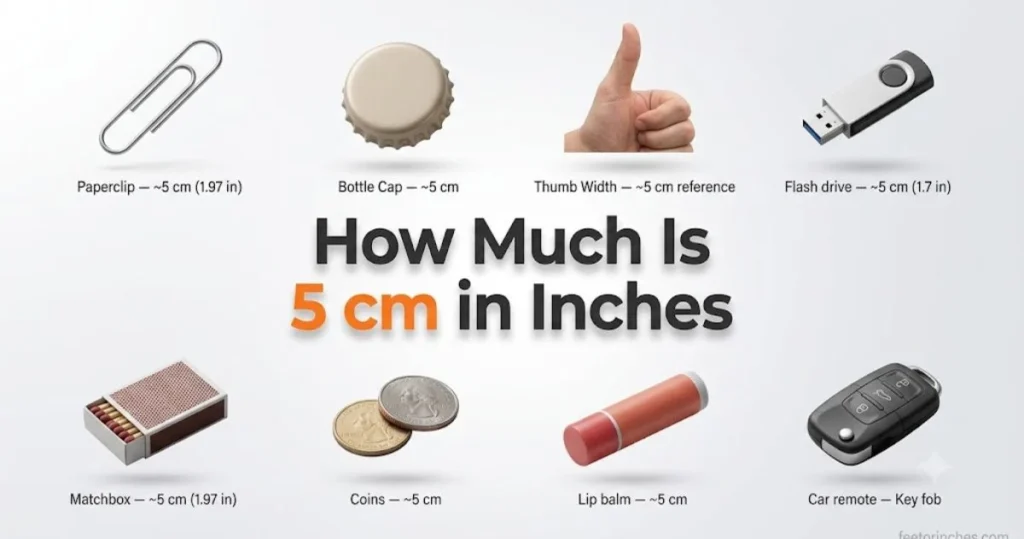
To help you visualize it, 5 cm is roughly the width of two stacked coins or the length of a small paperclip. It’s a short distance—small enough to fit easily in your hand, but still important in measurements for crafts, design, and precise DIY work.
In this guide, you’ll see conversions, real-life comparisons, and simple visuals so you can instantly understand what 5 cm looks like in inches in everyday life.
Conversion Table: Centimeters to Inches (Small Scale)
| Centimeters (cm) | Inches (in) | Real-World Feel |
|---|---|---|
| 1 cm | 0.39 in | Grain of rice length |
| 2 cm | 0.79 in | Fingernail width |
| 5 cm | 1.97 in | Small paperclip length |
| 10 cm | 3.94 in | Smartphone width edge |
| 15 cm | 5.91 in | Pencil length |
What Does 5 cm in Inches Really Mean?
To understand this properly, it helps to know the unit behind it. A centimeter is part of the metric system, while an inch belongs to the imperial system used mainly in the US.
Inch is defined as exactly 2.54 centimeters. This fixed relationship makes conversions precise and reliable.
So when you convert:
- 5 cm ÷ 2.54 = 1.9685 inches
- Rounded: 1.97 inches
This means 5 cm is just under 2 inches—small but noticeable in real-world objects like accessories, gadgets, or craft materials.
Why This Conversion Matters
Understanding how much is 5cm in inches is useful in many daily situations:
- Buying items online from international stores
- Reading clothing or shoe size charts
- DIY crafting and woodworking
- Measuring small objects in design projects
- Understanding product dimensions in electronics
Many global products list dimensions in centimeters, while you may think in inches. This conversion helps bridge that gap instantly.
How the Conversion Works (Simple Explanation)
The conversion between centimeters and inches is straightforward because it is fixed:
- 1 inch = 2.54 cm exactly
- So to convert cm → inches, you divide by 2.54
Step-by-step:
- Take the centimeter value (5 cm)
- Divide it by 2.54
- Get the result in inches
So:
- 5 ÷ 2.54 = 1.97 inches
No estimation needed—just a simple division.
Real-Life Examples of 5 cm (1.97 inches)
Here are practical examples to help you picture this length instantly:
Example 1: Paperclip Length
Measurement: ~5 cm
Visualization: A standard large paperclip
Why it helps: This is one of the easiest ways to imagine 2 inches.
Example 2: Matchbox Width
Measurement: ~5 cm
Visualization: The width of a small matchbox
Insight: Common household item for quick estimation.
Example 3: Two Coins Stacked
Measurement: ~5 cm
Visualization: Two large coins stacked vertically
Why it helps: Coins are everywhere and easy to compare.
Example 4: USB Drive Length
Measurement: 5–6 cm
Visualization: A compact flash drive
Insight: Many tech gadgets fall in this size range.
Example 5: Golf Ball Diameter (Slightly Less)
Measurement: ~4.3 cm
Comparison: 5 cm is slightly larger
Insight: Helps you understand relative scale.
Example 6: Bottle Cap Diameter
Measurement: ~5 cm (varies slightly)
Visualization: Soft drink bottle cap size range
Why it helps: Everyday kitchen reference.
Example 7: Small Sticky Note Edge
Measurement: ~5 cm segment
Visualization: Half side of a sticky note
Insight: Useful for office-related estimation.
Example 8: Adult Thumb Width (Across)
Measurement: ~5 cm
Visualization: Width of a large adult thumb
Why it helps: Human body-based measurement is intuitive.
Example 9: Key Fob Size
Measurement: 4–6 cm
Visualization: Car key remote
Insight: Common everyday carry item.
Example 10: Lip Balm Tube Height (Partial)
Measurement: ~5 cm segment
Visualization: Half of a lip balm stick
Why it helps: Common cosmetic comparison.
Comparison: 5 cm vs Other Sizes
Smaller than 5 cm:
- Fingernail width (~2 cm)
- Small coin (~2–3 cm)
- USB connector (~2–3 cm)
Equal or close to 5 cm:
- Paperclip length
- Bottle cap diameter
- Thumb width
Larger than 5 cm:
- Smartphone thickness (~7–9 cm width range)
- Credit card length (~8.5 cm)
- TV remote (~15–20 cm)
How 5 cm Feels in Real Life
In human experience, 5 cm feels small but clearly noticeable:
- You can easily hold it between your fingers
- It fits inside your palm without stretching
- It’s roughly the size of a short jump in measurement terms
- Walking-wise, it’s completely negligible (you wouldn’t feel it as distance)
In furniture or room terms, 5 cm is too small to matter structurally, but very important in fine adjustments like spacing, alignment, and fitting.
Practical Uses of 5 cm Measurement
You’ll commonly encounter this size in:
Construction & DIY
- Screw length spacing
- Tile gaps
- Wood trimming adjustments
Interior Design
- Curtain hemming
- Shelf alignment
- Small décor spacing
Shopping
- Product dimensions on Amazon or AliExpress
- Jewelry sizing
- Accessory measurements
Education
- Geometry exercises
- Measurement conversions
- Science lab work
Fashion
- Belt width
- Bracelet sizing
- Small tailoring adjustments
Frequently Asked Questions (FAQs)
How much is 5 cm in inches exactly?
5 cm equals 1.9685 inches. It is commonly rounded to 1.97 inches for simplicity in everyday use and quick calculations.
Is 5 cm bigger than 2 inches?
No, 5 cm is slightly smaller than 2 inches. Since 2 inches equals 5.08 cm, 5 cm falls just below it.
How do I convert cm to inches quickly?
Divide the centimeter value by 2.54. This gives you the exact inch equivalent without needing a calculator app.
What does 5 cm look like in real life?
It is roughly the size of a paperclip, bottle cap, or a large coin stack. It’s small but easy to visualize.
Why is 1 inch equal to 2.54 cm?
This is a fixed international standard used for consistency in measurement systems across countries and industries.
Is 5 cm a common measurement?
Yes, it appears frequently in DIY, fashion, packaging, and electronics dimensions, especially in compact products.
How accurate should I be when converting 5 cm?
For most practical uses, rounding to 1.97 inches is enough. For engineering or precision work, use 1.9685 inches.
Can I estimate 5 cm without a ruler?
Yes. Use your thumb width or a paperclip as a quick reference for approximate measurement.
Conclusion
Understanding how much is 5cm in inches helps you quickly interpret measurements across different systems. At 1.97 inches, 5 cm is a small but practical length you’ll often see in everyday objects like stationery, gadgets, and household items.
Once you visualize it through real-world examples, conversions become much easier and faster—especially when shopping, crafting, or working with international measurements.